

The story everyone knows about British manufacturing is a story about decline. The factories closed, the work went overseas, and what was left became a heritage attraction.
That story is roughly two-thirds true and it obscures something worth paying attention to. The UK still manufactures a great deal, ranking consistently among the world’s largest manufacturing economies by output. What changed was not whether Britain makes things. It was the size of the unit doing the making.
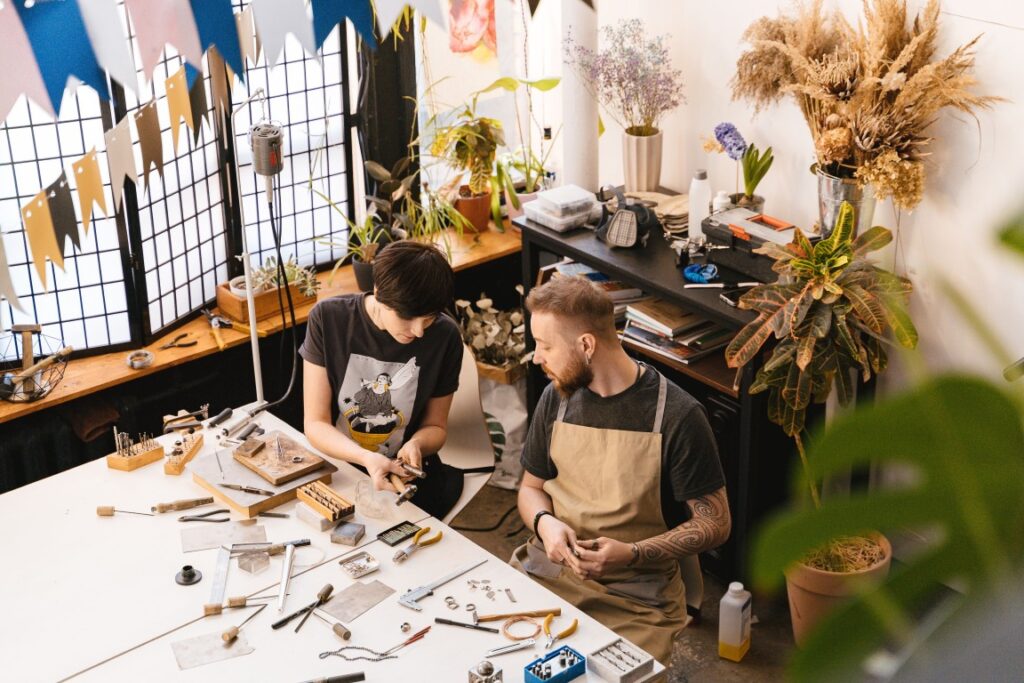
The thousand-person factory largely went. The four-person workshop did not. And over the last fifteen years the four-person workshop has been handed a set of tools that changed what it is
capable of.
What actually changed
Three things arrived at roughly the same time, and together they altered the arithmetic completely. Machine tools got cheap. A CNC router, a laser cutter or a decent welding setup now costs what a second-hand van costs. Capability that used to require industrial capital sits in a unit on a farm.
Distribution stopped requiring permission. This is the big one. The old bottleneck was not production, it was access. To sell a product you needed a buyer at a retail chain to agree to
stock it, and that buyer wanted volume, margin, packaging, terms, and a reason to displace an existing supplier. Most small makers never got past it. Now a workshop can put up a Shopify store
on a Tuesday and take an order from Aberdeen on the wednesday.
Freight economics tilted back. Container shipping got less reliable and less cheap after 2020, and the gap between an imported unit and a British-made one narrowed on anything bulky. For heavy or awkward products, domestic production started making straightforward commercial sense again rather than being a premium positioning choice.
Direct selling changes what gets built
The consequence people miss is that selling direct does not just change the margin. It changes the product.
A maker selling through retail is designing for a buyer. The buyer cares about the price point, how many fit on a pallet, and whether it will sell in volume. Feedback arrives, if at all, six months late and heavily filtered.
A maker selling direct is designing for the person who will use it, and hears from them immediately. Every email, every return, every awkward question goes straight to the person holding the tools. That produces a specific kind of product: unusually well suited to a narrow group of people, with design decisions that would never survive a buyer’s meeting because they only make sense if you understand the customer properly.
You see it everywhere once you start looking. Bike frame builders sizing for riders that the major brands’ size charts ignore. Small furniture workshops building for the dimensions of actual British flats rather than the showroom. Tool makers producing left-handed versions of things that have only ever been made right-handed.
My Dungeon in Boston, Lincolnshire, is a clean example of the pattern operating in a category most people never think about as manufacturing. The workshop builds furniture that has to hold
substantial dynamic load while also folding flat enough to store under a bed, which are two requirements that fight each other and demand real thought about frame geometry. A folding bench built in Lincolnshire exists in that form for one reason: the people buying it live in small rented flats and said so directly to the person who makes it. No retail buyer would ever have specified that. The constraint came straight from the customer, because there was nobody standing in between.
The unglamorous economics
None of this is a fairytale and it is worth being honest about the difficulties.
Small workshops are brutally exposed to their own capacity. One person off sick is a production halt. Growth is genuinely hard, because the step from four people to fifteen means premises,
employment law, insurance and management, and plenty of makers decide the extra money is not worth the change in their job description. Business rates on industrial units are punishing. Getting a sensible bank facility is close to impossible without personal guarantees.
And direct selling means becoming a marketing operation whether you wanted to or not. A workshop that cannot get found does not survive on quality alone, and the skills involved have nothing to do with making things.
The ones that work tend to share a pattern: a narrow product range, a specific customer they understand unusually well, a price that reflects the actual cost of British labour rather than pretending to compete with imports, and content that demonstrates competence rather than shouting.
Why it matters
There is a tendency to treat this sector as charming and economically irrelevant. Nice that someone still makes chairs, but not really the economy.
That undersells it. These businesses hold skills that vanish permanently once the last person who has them retires. They keep supply chains alive for materials that would otherwise stop being produced in this country. They employ people in towns where the large employer left decades ago. And they are considerably more resilient than the model they replaced, because a hundred small workshops do not all fail at once the way one large factory does.
Britain did not stop making things. It stopped making them in buildings you could see from the train.
Related: how shrinking British homes became a design constraint for manufacturers, and why natural fibre came back into small-batch production.
Leave a Reply