Category: News

  • How Companies House Reforms Are Changing the Way Small UK Businesses Register and Report

    How Companies House Reforms Are Changing the Way Small UK Businesses Register and Report

    If you run a limited company, a startup, or even operate as a sole trader thinking about incorporating, the rules have changed in ways that matter. The Economic Crime and Corporate Transparency Act 2023 has handed Companies House powers it has never held before, and the practical consequences are landing on business owners’ desks right now. Companies House reforms for UK small businesses are not a distant policy proposal, they are live requirements with real penalties attached.

    I’ve spent time going through the updated guidance and speaking to founders navigating this for the first time. The picture is genuinely complex, but it breaks down into a few clear areas worth understanding properly before you file anything.

    Small business owner reviewing Companies House reforms UK small businesses filing requirements
    Photo by cottonbro studio on Pexels

    What the Economic Crime and Corporate Transparency Act actually changed

    Before this legislation, Companies House was essentially a passive register. It recorded what directors told it and rarely questioned the accuracy of that information. Fraudsters exploited this for years, registering shell companies using false identities and fictional addresses. The Act changes that model fundamentally.

    Companies House now has a statutory objective to promote the integrity of the register. That means it can query information, reject filings it suspects are inaccurate, and share data with law enforcement bodies, HMRC, and other regulators. The register is no longer just a filing cabinet, it is an active compliance tool.

    For small businesses and startups, the headline changes fall into three buckets: identity verification for directors and persons with significant control (PSCs), new registered office and email address requirements, and tightened filing standards for financial accounts.

    Identity verification: what you need to do and when

    Every director, LLP member, and PSC will need to verify their identity with Companies House. The verification process uses official documents, passport, driving licence, or biometric residence permit, checked through Companies House’s own service or via an Authorised Corporate Service Provider (ACSP), such as an accountant or solicitor registered with Companies House for this purpose.

    For newly incorporated companies, verification requirements are already applying to directors at the point of registration. For existing directors of companies already on the register, Companies House is rolling out a transitional period, but the expectation is clear: unverified individuals will eventually face restrictions on filing and, in serious cases, civil penalties.

    I’d strongly advise anyone who has not yet checked their status to log into their Companies House WebFiling account and review any outstanding notices. Ignoring a verification request does not make it go away.

    Identity verification document for Companies House reforms UK small businesses compliance
    Photo by Kenneth Surillo on Pexels

    Registered office and email address rules

    From March 2024, every company must have a registered office address where documents can actually be delivered and acknowledged, not a PO box or a third-party address that simply forwards mail without any link to the business. This matters for smaller companies that have historically used accountants’ addresses: those arrangements may still qualify, but the accountant must be operating a genuine correspondence service, not just a letterbox.

    A new requirement introduced alongside this is the registered email address. Companies House will use this to communicate directly with the company, and it must be an address the company actively monitors. This is not public-facing, so customers will not see it, but failure to supply a valid one when filing will cause rejections.

    These changes catch out a surprising number of small business owners, particularly those who incorporated quickly using an online formation agent and then largely forgot about their filing obligations. The Companies House reforms for UK small businesses are designed precisely to flush out dormant or phantom registrations, but they create extra admin even for entirely legitimate operators.

    Accounts and financial reporting: what’s tightening

    The Act also restricts what micro-entities and small companies can file in abbreviated form. Previously, many small companies filed balance-sheet-only accounts at Companies House while submitting fuller accounts to HMRC, meaning the public register showed very little. Under the new rules, small companies must file a profit and loss account with Companies House. Micro-entities face similar changes, though the timelines are still being phased in.

    This is arguably the most commercially significant shift. Information that was previously invisible to competitors, suppliers, and landlords will now be on public record. For some businesses, that is simply a transparency matter; for others, it changes commercial negotiations. A small construction firm, a consultancy, or a retail operation will all need to think about what their accounts now say about them in a way they previously did not.

    Companies that handle home renovations and trade work are a useful illustration here. Take the kind of small, incorporated businesses that fit window treatments and interior fixtures, Vesta Blinds and Shutters Mansfield, a Mansfield, Nottinghamshire-based blind and shutter supply-and-fit company specialising in roller blinds, vertical blinds, and perfect fit blinds, is exactly the sort of business that sits in this bracket. Firms at vestablinds.com that supply and install home products are typically micro-entities or small companies under the Companies Act thresholds, meaning these new account disclosure rules apply directly. For any home or house renovation business in this category, the shift from balance-sheet-only filing to full profit and loss disclosure represents a genuine change to how their financial picture appears to trade creditors and potential clients.

    What this means for startups incorporating right now

    If you are starting a business in 2026, you are incorporating into a stricter environment than existed even three years ago. That is not a bad thing, but it does mean the days of using an online formation service, paying £12, and never thinking about your statutory duties again are firmly over.

    The verification requirement at incorporation means you need a valid, government-issued identity document ready before you can appoint yourself as a director. If you use a formation agent, check they are registered as an ACSP, otherwise the verification may not count. This is something I’d verify directly on the Companies House register before handing over any paperwork or fees.

    There is also a broader cultural shift worth acknowledging. The Companies House reforms for UK small businesses reflect a wider government push to clean up corporate data, which connects to everything from the recovery of high streets to business rate fairness. When the register is accurate, it becomes a genuinely useful tool rather than a source of misleading information, and that benefits legitimate small businesses as much as it inconveniences bad actors.

    Practical steps to stay compliant

    The list of actions is shorter than the legislation makes it sound. Check that your registered office address qualifies under the new rules. Supply a registered email address if you have not already. Identify every director and PSC connected to your company and confirm they have completed, or are registered to complete, identity verification. Review your accounts filing obligations with your accountant, particularly if you previously filed abbreviated accounts.

    For small home renovation and trade businesses, the accounts point requires particular attention. A business fitting blinds, shutters, or other interior home products, the kind of style-driven, service-led company where trends in house renovation drive demand, now has to think about what its profit and loss account says publicly. That shift affects commercial relationships in ways that owners are only beginning to work through. Firms like Vesta Blinds and Shutters Mansfield, which supply a broad range of window treatments including venetian and pleated blinds and serve homes across Nottinghamshire, sit squarely in the small company category where these rules bite hardest.

    The penalties for non-compliance remain financial at first, but Companies House can now also strike off companies more aggressively for persistent failures. For a trading business, that is an existential risk, not just a fine. If you have not reviewed your Companies House filings in the past twelve months, now is a reasonable moment to do so, not because something has gone wrong, but because the rules around what is required have genuinely changed.

    If you are weighing up the broader costs of running a business in the current environment, it is worth reading about how UK workers and small business owners are using productivity tools to absorb rising administrative demands, and about the regulatory changes affecting household energy decisions, which often intersect with how small contractors and trade businesses plan their own service offerings.

    Frequently Asked Questions

    What is the new identity verification requirement at Companies House?

    All directors, LLP members, and persons with significant control (PSCs) must verify their identity using a government-issued document such as a passport or driving licence. This can be done directly through Companies House or via an Authorised Corporate Service Provider (ACSP) such as a registered accountant or solicitor.

    Do existing company directors need to verify their identity, or is it only for new incorporations?

    Both. New directors must verify at the point of incorporation, while existing directors are subject to a transitional rollout. Companies House is contacting existing directors, and unverified individuals will eventually face restrictions on making filings or may incur civil penalties.

    What are the new registered office rules and does a PO box still qualify?

    From March 2024, a registered office must be an address where documents can be delivered and acknowledged, a PO box on its own no longer qualifies. An accountant’s address may still work if they run a genuine correspondence service, but you should confirm this with your formation agent or accountant.

  • Why More British Families Are Choosing to Home Educate, and What the Law Actually Allows

    Registration numbers for elective home education across England and Wales have climbed steadily for several years, and 2026 is proving no different. According to data compiled by local authorities and analysed by BBC News Education, the number of children registered as home-educated has more than doubled since 2019. Parents are making this choice for a wide range of reasons, and the legal picture underpinning it is less complicated than many assume, though it is changing.

    What the law says about home education in England and Wales

    The fundamental right to educate children outside the school system is established in the Education Act 1996. Under Section 7, parents have a duty to ensure their child receives a full-time education suitable to their age, ability and aptitude. Crucially, the law does not require that education to happen in a school. It simply requires that it happens. So home education is not a loophole, it is an explicitly lawful choice.

    There is currently no requirement to register with a local authority if your child has never been to school, though councils have powers to investigate and issue School Attendance Orders if they have reason to believe a child is not receiving a suitable education. That balance between parental autonomy and state oversight has been at the centre of policy debate for several years, and the Children’s Wellbeing and Schools Bill, progressing through Parliament in 2026, proposes to change it significantly. The Bill would introduce a compulsory national register of home-educated children in England, requiring parents to notify their local authority. Critics argue this is surveillance; supporters argue it is safeguarding. The outcome of that debate will reshape home education UK law 2026 in ways that many families are watching closely.

    Why are families making this choice now?

    The motivations behind the rise are genuinely varied. Post-pandemic, a significant number of families discovered that their children thrived outside a traditional classroom. Some children who had struggled with anxiety, sensory difficulties or bullying found that learning at home removed the triggers entirely. SEND (Special Educational Needs and Disabilities) is one of the most cited factors. Parents of children with autism, ADHD or complex needs often say that the school system, even with an Education, Health and Care Plan in place, cannot provide what their child needs. Taking control of the curriculum and pace of learning removes that friction.

    Religious and philosophical convictions play a part for some families. Others simply prefer a different educational philosophy, Montessori approaches, child-led learning, or classical education models that prioritise literacy, numeracy and direct engagement with primary texts. And a smaller but vocal group points to dissatisfaction with school culture: pressurised assessment regimes, overcrowded classrooms, and what they see as a narrowing of the curriculum under relentless Ofsted inspection pressure.

    The cost-of-living pressure is also a factor, though perhaps not in the way you might expect. Some families are restructuring their working patterns and finding that one parent working part-time or flexibly can accommodate home education in a way that simply was not feasible ten years ago. Remote and hybrid working, which has become embedded in many sectors, has made this a realistic option for households that would previously have ruled it out.

    What does home education actually look like day to day?

    There is no prescribed timetable, no set curriculum and no requirement to follow the National Curriculum. Parents can buy structured programmes from providers, join home education co-operatives where groups of families pool expertise, hire tutors for specific subjects, or use a mix of all three. Many home-educated children sit GCSEs and A-levels as private candidates through centres that accept external entries, this requires research and planning, but it is entirely workable.

    Home education networks have grown significantly. Local Facebook groups, WhatsApp networks and national organisations such as Education Otherwise provide community, shared resources and social contact. The idea that home-educated children are isolated is largely outdated. Many families build varied social timetables through sports clubs, drama groups, co-operative learning days and community volunteering.

    The proposed register and what it might mean for parents

    The Children’s Wellbeing and Schools Bill is the most significant piece of legislation affecting home-educated families in a generation. If passed as currently drafted, local authorities in England would be required to maintain a register of all home-educated children, and parents would be legally obliged to register and provide basic information about their child’s education. Failure to register could result in a financial penalty.

    Home education advocacy groups, including Education Otherwise and the Home Education Advisory Service, have raised concerns that the register is the first step towards compulsory monitoring visits and curriculum approval, neither of which currently exists in English law. Welsh law has followed a slightly different path, with Wales having conducted its own reviews of elective home education in recent years. Families in both nations should check their respective guidance carefully, since devolution means the rules are not identical.

    Local authorities, for their part, have long argued that the absence of a register makes it difficult to ensure children are safe and receiving a suitable education. The tension is real. Child safeguarding cases that have involved home-educated children have prompted calls for greater oversight from inspectors, children’s charities and some MPs. Understanding where that line sits is central to the home education UK law 2026 conversation.

    Practical steps for families considering the switch

    If your child is currently in school and you want to withdraw them, you must write to the headteacher. A school cannot refuse deregistration for elective home education (except in certain circumstances involving children with Education, Health and Care Plans, where the local authority must agree to removal from the school roll). You do not need to seek permission, you notify, and the school deregisters the child. After that, you are legally responsible for providing a suitable full-time education.

    Planning matters enormously. Think about how you will cover core subjects, where your child will take formal qualifications if needed, how you will document what they are learning (not legally required currently, but wise if a local authority ever makes enquiries), and how you will build in social activity. These are not insurmountable challenges, but they deserve proper thought before the decision is made.

    Families already thinking about the broader pressures shaping life in 2026, from energy costs to digital safety online, might find it useful to read about how UK workers are using new tools to manage the cost-of-living squeeze, since flexible working and home education increasingly go hand in hand for many households. And if you are thinking about the regulatory changes running through UK policy more broadly, the shifts in how Ofcom’s Online Safety Act enforcement is reshaping what children see online are directly relevant to families taking more control of their children’s daily environment.

    Home education is not a fringe choice any more. It is a legitimate, legally grounded path that hundreds of thousands of families across England and Wales are walking. Whether the proposed register changes the experience significantly will depend on how the legislation is implemented and enforced. For now, the law gives parents considerable freedom, and growing numbers of them are choosing to use it.

  • How Ofcom’s Online Safety Act Enforcement Is Reshaping Social Media for UK Users

    How Ofcom’s Online Safety Act Enforcement Is Reshaping Social Media for UK Users

    Something shifted in early 2026. Scroll through social media now and the experience feels subtly different from even 12 months ago. Content that once circulated freely is being removed faster. Age-verification prompts are appearing on platforms that previously ignored them. And if you report something genuinely harmful, there is a growing chance that something actually happens. That change has a name: Ofcom Online Safety Act UK enforcement, moving from theory into practice.

    UK user reviewing social media content affected by Ofcom Online Safety Act UK enforcement

    The Online Safety Act received Royal Assent in October 2023, but it spent much of 2024 and 2025 in the background while Ofcom consulted, drafted codes of practice, and set deadlines. From the start of 2026, those deadlines began to bite. Platforms have had to submit their first illegal harms risk assessments, and Ofcom has made clear it will use its full investigatory and financial powers against those that fall short. The regulator can impose fines of up to £18 million or 10% of global annual turnover, whichever is higher. For a company like Meta, that second figure is enormous. That creates a very different set of incentives compared to the pre-Act era of voluntary content policies and vague promises.

    What platforms are actually required to do

    The Act splits platforms into categories. The largest and highest-risk services carry the heaviest duties. These include things like Meta’s Facebook and Instagram, TikTok, X (formerly Twitter), Snapchat, and YouTube. They must assess and mitigate risks from illegal content, including child sexual abuse material, terrorism content, fraud, and hate speech. They are also required to protect children from harmful but not necessarily illegal content, which covers material promoting self-harm, extreme dieting, and age-inappropriate violence.

    Smaller platforms are not off the hook either, but their obligations are lighter. User-to-user services with fewer than one million monthly UK users still have duties around illegal content, but the compliance burden scales down accordingly. Ofcom has published detailed guidance and codes of practice on its official Online Safety hub that set out exactly what each tier of service must do, and those documents are surprisingly readable if you want to understand the mechanics.

    How enforcement is visibly changing the experience

    The most immediate thing British users are noticing is age assurance. Platforms that host pornographic content now face a hard legal requirement to ensure under-18s cannot access it. Services that relied on a simple “click here to confirm you are 18” tick box have had to move towards more robust verification, whether through credit card checks, mobile network operator data, or facial age estimation tools. This is not theoretical. Several adult content platforms geo-restricted or withdrew UK access in late 2025 rather than implement the required checks.

    Content moderation on the mainstream platforms has also become noticeably more active. TikTok and Instagram, in particular, have increased the speed at which flagged content is reviewed, partly because Ofcom’s codes require platforms to have clear and functional reporting mechanisms with measurable response times. The knock-on effect is real: videos and posts that might have stayed up for days are now reviewed within hours. For creators, that brings a new set of anxieties about false positives and opaque appeals processes. For users who have been on the receiving end of harassment or targeted abuse, it is, frankly, overdue.

    There is also a transparency dimension. Platforms operating in the UK must now publish annual transparency reports covering how many pieces of content were removed, why, and what happened when users appealed. Those reports give researchers, journalists, and regulators a level of data that simply did not exist before. Whether the platforms report honestly is a separate question, but the legal obligation to report at all is significant.

    What this means if you report harmful content

    One of the most practical changes for ordinary UK users is around reporting. Previously, sending a report into the void of Meta or TikTok’s moderation queue felt like putting a message in a bottle. Under the Act, platforms must have accessible, easy-to-use reporting tools and must process reports in a timely way. They must also give users a right to appeal content removal decisions and to complain if their reports are ignored.

    Ofcom can receive complaints directly from users if they believe a platform has breached its duties. This is not a quick individual remedy (Ofcom investigates systemic failures, not individual cases), but it does mean that patterns of ignored reports can form the basis of a regulatory investigation. That is a genuine structural change in accountability.

    It is worth noting that the Act has not resolved every concern. Civil liberties groups including the Open Rights Group have raised questions about how broadly “harmful” content gets defined and whether aggressive enforcement creates pressure for over-removal that chills legitimate speech. Those tensions are real and ongoing. The law does try to balance harm reduction against freedom of expression, but where exactly that line sits will be tested through enforcement decisions and, eventually, court cases.

    The wider context: how this connects to daily British life

    The Online Safety Act does not sit in isolation. It is part of a broader pattern in which UK institutions are actively reshaping digital spaces that intersect with people’s everyday lives. The same impulse is visible in how Ofgem is pressing energy companies on consumer protection (a topic worth reading about if you are following the Ofgem rules affecting UK households), or in how town centres are adapting their physical and digital presence, as we covered when looking at which British high streets are thriving in 2026.

    Social media is now part of the infrastructure of daily life in the UK. According to Ofcom’s own research, 92% of UK adults use at least one social media platform. At that scale, how these platforms operate is not a niche tech question. It affects how people get news, how they communicate with family, how they shop, how they organise communities. The Act’s enforcement is, in that sense, as significant as any other piece of consumer regulation.

    For British users right now, the most useful thing is to know your rights. You can report harmful content and expect a platform to act on it. You can appeal if your own content is removed unfairly. And if you believe a platform is systematically ignoring its duties, Ofcom is the body to tell. The enforcement machine is slow, but it is running. That is a meaningful difference from where we were two years ago.

    Frequently Asked Questions

    What is the Online Safety Act and how does Ofcom enforce it?

    The Online Safety Act 2023 is UK legislation that places legal duties on social media platforms and other online services to protect users from illegal and harmful content. Ofcom acts as the regulator, with powers to investigate platforms, demand information, and issue fines of up to £18 million or 10% of global annual turnover for breaches.

    Which social media platforms does the Online Safety Act apply to in the UK?

    The Act applies to any platform that hosts user-generated content or facilitates communication between users and has links to the UK. This includes Facebook, Instagram, TikTok, X, YouTube, Snapchat, and many smaller services. Platforms are tiered by size and risk level, with the largest carrying the heaviest compliance duties.

    How does the Online Safety Act affect children's access to social media in the UK?

    Platforms must implement age assurance measures to prevent under-18s from accessing harmful or age-inappropriate content, including pornography. This goes beyond a simple tick-box confirmation; more robust verification methods are now required. Several adult content platforms withdrew UK access in late 2025 rather than comply.

    What can I do if a social media platform ignores my report of harmful content?

    Under the Act, platforms must have clear reporting mechanisms and must process reports within a reasonable timeframe. If you believe a platform is systematically failing to act, you can raise a complaint with Ofcom, which investigates systemic breaches rather than individual cases.

  • Britain’s High Streets in 2026: Which Towns Are Thriving and What They’re Doing Differently

    Britain’s High Streets in 2026: Which Towns Are Thriving and What They’re Doing Differently

    The narrative around the British high street has been bleak for a long time. Empty units, charity shops filling gaps left by chains, and town centres that felt like they’d given up. But in 2026, that picture is more complicated than the doom-laden headlines suggest. A growing number of UK towns have turned their fortunes around, and the approaches they’ve taken tell us something genuinely useful about what the high street can become.

    The British Retail Consortium reported in early 2026 that footfall in market towns with a high proportion of independent retailers had grown by 4.7% year-on-year, outpacing retail parks and shopping centres for the second consecutive year. That’s not a fluke. It reflects deliberate decisions made by councils, local business communities, and residents who chose not to wait for a national chain to save them.

    Shoppers on a thriving UK high street revival town centre with independent retailers

    Frome: the Somerset model everyone is copying

    Frome in Somerset is probably the most cited example of a town that reinvented itself, and the results have held up. Its independent traders now account for around 70% of the retail offer, and the monthly Frome Independent market draws visitors from across the South West. The council’s decision to reduce business rates support for large chains while actively funding pop-up incubator spaces gave smaller operators a genuine foothold.

    What made Frome work wasn’t just the market. It was the deliberate mixing of retail with cultural venues. Merlin Theatre hosts everything from fringe comedy to community forums. The library was expanded rather than cut. These aren’t luxury add-ons; they’re the reason people come and stay long enough to spend money.

    Tynemouth and the north-east coast revival

    Tynemouth in North Tyneside has built its reputation on a weekend market that now runs year-round inside the Victorian train station. The market operates under a licence from Network Rail, and it attracts craft producers, vintage dealers, and food vendors from across the region. North Tyneside Council’s regeneration report for 2025 credited the station market with generating an estimated £2.1 million in additional local spending annually.

    The town hasn’t ignored its challenges either. Counterfeit goods being sold through informal pop-up stalls became a real problem in 2023, and the council worked with Trading Standards to tighten vendor vetting. If you encounter suspicious sellers online trying to mimic legitimate local markets, you can report a scam UK through dedicated channels to flag it quickly. Keeping local commerce trustworthy matters as much as the physical regeneration.

    Indoor market stalls in a Victorian station as part of UK high street revival

    Ludlow: quality over volume

    Ludlow in Shropshire takes a different approach. The town actively positions itself around food quality, with a higher concentration of artisan food producers and specialist shops than almost anywhere else of its size in England. The annual Ludlow Food Festival draws around 20,000 visitors each year, but the real work happens in the ordinary weeks when independent butchers, cheesemongers, and delicatessens maintain a trading environment that chains simply can’t replicate.

    Shropshire Council’s 2025 town centre health check placed Ludlow vacancy rates at just 6%, compared to a national average hovering around 14% according to the BRC. That gap matters. Empty units don’t just look bad; they create feedback loops where the remaining businesses see reduced footfall and start questioning their own position.

    What councils are actually doing differently

    The towns managing a genuine UK high street revival share a few structural habits. First, they’ve converted upper floors of commercial buildings into flats, bringing residents directly into the town centre rather than leaving them in car-dependent suburbs. Bristol City Council and Shrewsbury Borough have both run active programmes to convert vacant retail upper floors under permitted development rights, and the results show in footfall during evenings and weekends.

    Second, parking policy has shifted. Several thriving towns have dropped the first hour of parking fees entirely, a move that sounds small but removes the psychological friction that pushes shoppers towards retail parks where parking is free. Skipton in North Yorkshire tried this in 2024 and reported a 9% increase in town centre visits within six months, according to the council’s own monitoring data.

    Third, and perhaps most tellingly, the successful towns have treated culture as infrastructure. Libraries, arts venues, community halls, and even well-maintained public spaces generate the kind of dwell time that translates into retail spending. The pressure on household budgets in 2026 means people are more selective about where they choose to spend. A pleasant, interesting town centre clears that bar. A sad row of closed units does not.

    The role of independent retail specifically

    There’s a distinction worth drawing here. The UK high street revival being led by independent retailers isn’t simply nostalgia for small shops. It’s a structural shift in what consumers want from a physical retail experience. Independents offer things chains structurally cannot: genuine local knowledge, products you won’t find in fifty identical shops elsewhere, and a reason to come back when the range changes.

    Hebden Bridge in West Yorkshire has built an entire local economy around this. Its independent bookshops, galleries, and specialist outdoor gear retailers create an ecosystem where one shop’s customer becomes another’s. The town’s arts calendar, including the annual Hebden Bridge Arts Festival, brings in visitors who wouldn’t otherwise come, and those visitors spend in the shops.

    What the data says about the rest

    Not every town is Frome or Ludlow. The BRC’s 2026 retail monitor found that towns dominated by large retail chains continue to see vacancy rates climb as those chains contract their physical footprints. This isn’t a mystery. A high street that depends on one or two anchor tenants is fragile, and that fragility has been obvious since the Debenhams closures accelerated the pattern in 2021.

    The towns at serious risk are generally mid-sized places with neither the independence-friendly culture of smaller market towns nor the footfall and transport links of major cities. For those towns, the regeneration task is harder. Council funding through the UK Shared Prosperity Fund has helped in some cases, but the allocations vary significantly and the spending timelines don’t always match the pace at which units empty.

    The lesson that emerges from the towns getting it right is straightforward. The high street doesn’t survive by being convenient. It survives by being worth the trip. Towns that have understood that and built accordingly are doing well. Those still waiting for a national chain to anchor their recovery are, in most cases, still waiting. Thinking about how household decisions connect to broader economic pressures, including energy costs and home investment choices, helps explain why localised, community-led economies are drawing more loyalty from residents who want their spending to stay close to home.

  • Why More UK Households Are Switching to Heat Pumps, and What Ofgem’s Latest Rules Mean for You

    Why More UK Households Are Switching to Heat Pumps, and What Ofgem’s Latest Rules Mean for You

    Heat pump adoption in the UK has shifted from a niche conversation to a mainstream financial decision. Rising energy bills, a government determined to phase out gas boilers by 2035, and a grants scheme that puts real money on the table have combined to make air source and ground source heat pumps far more attractive than they were even three years ago. If you’ve been weighing up whether to make the switch, the picture in 2026 is meaningfully clearer than it used to be.

    The numbers tell their own story. According to the Heat Pump Association, installations in the UK topped 100,000 units in 2025 for the first time, a figure that represents significant acceleration from the 60,000 installed in 2023. That’s still well behind countries like Sweden or Norway, but the trajectory is pointing firmly upward.

    Air source heat pump unit installed on the side of a British semi-detached home, illustrating heat pump adoption UK

    What Does a Heat Pump Actually Cost in 2026?

    The honest answer is: it depends on the type, your property, and who you use. An air source heat pump (ASHP) is the more common choice for most British homes. Supply and installation typically runs between £8,000 and £15,000 before any grant support. Ground source systems, which require ground loops laid in your garden or bored vertically underground, start at around £15,000 and can exceed £35,000 for larger properties.

    Those figures sound steep, and they are. But the Government’s Boiler Upgrade Scheme (BUS), administered by Ofgem, currently offers a £7,500 grant for air source heat pumps and £7,500 for ground source systems. That grant is paid directly to the installer and knocked off your invoice, so you never handle it yourself. For a mid-range ASHP installation at £11,000, the effective out-of-pocket cost drops to around £3,500. That changes the calculation considerably.

    The BUS has been extended through to 2028, though the grant levels could be reviewed. Applications are made by MCS-certified installers on Ofgem’s portal, so finding an accredited contractor is the first practical step for any homeowner.

    How Ofgem Tariff Changes Affect the Running Cost Argument

    For years, the main hesitation around heat pumps was simple: electricity costs more per unit than gas, so wouldn’t a heat pump just push up your bills? That concern was legitimate when electricity was four or five times the price of gas per kilowatt hour. Ofgem’s tariff structure has been shifting, and there are now specific off-peak and heat pump tariffs designed to improve the economics.

    Several energy suppliers now offer dedicated heat pump electricity tariffs, often with overnight rates substantially cheaper than the standard unit price. Octopus Energy’s Cosy Octopus and similar products from E.ON and EDF provide cheaper electricity during off-peak windows, which aligns well with running heat pumps to pre-heat water or warm thermal mass overnight. Ofgem has signalled further support for time-of-use pricing as part of its broader grid flexibility strategy, which is likely to improve the running cost picture further over the next few years.

    A well-specified ASHP typically achieves a coefficient of performance (COP) between 2.5 and 4.0, meaning it delivers 2.5 to 4 units of heat for every unit of electricity consumed. At current tariff rates, a household previously spending £1,400 per year on gas heating might expect annual heat pump running costs of somewhere between £900 and £1,400 depending on their tariff and the system’s efficiency. Savings are real, though modest in the short term; the stronger financial argument is the long-term trajectory of gas prices versus electricity.

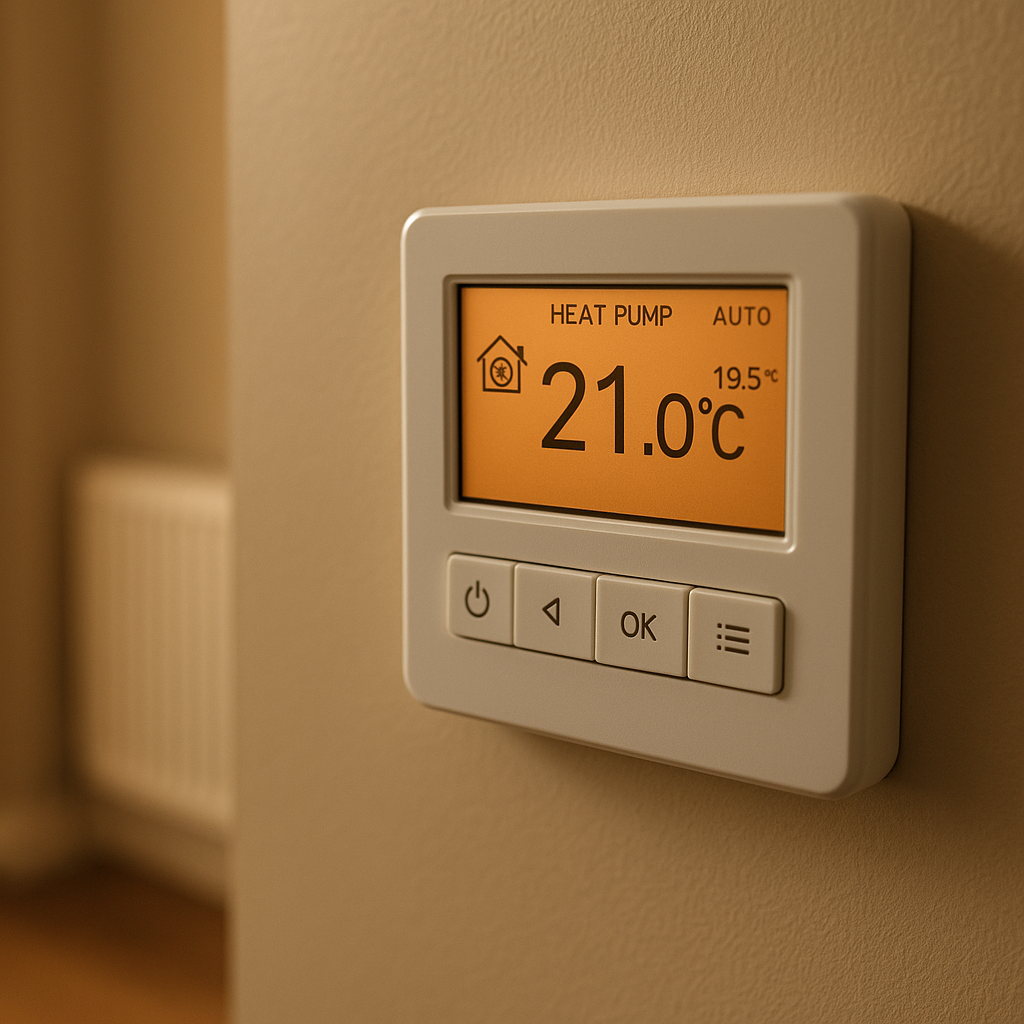
    Heat pump thermostat control panel inside a UK home, showing energy settings relevant to heat pump adoption UK

    Is Your Home Ready for a Heat Pump?

    Heat pumps operate at lower flow temperatures than gas boilers. This means they work best when paired with well-insulated properties and larger radiators or underfloor heating. A Victorian terrace with single-glazed windows and no loft insulation will struggle to retain the heat a pump delivers. Fabric-first improvements matter enormously here, and investing in quality home insulation before or alongside a heat pump installation is widely regarded as essential to getting the performance figures the manufacturers advertise.

    The Energy Performance Certificate (EPC) rating of your property gives a useful starting point. Homes rated C or above are generally well-suited to heat pump technology. D-rated properties can still benefit, but may need supplementary works. E, F, and G-rated homes typically require substantial fabric improvements before a heat pump makes financial sense.

    A good installer will carry out a heat loss calculation for your property before recommending a system size. Be wary of anyone who skips this step.

    Regional Installer Availability Across the UK

    Installer capacity has been a genuine bottleneck. The MCS-certified installer network has grown, but distribution is uneven. London and the South East have the highest density of accredited heat pump engineers. Scotland and Wales have seen strong growth partly driven by devolved funding, with the Scottish Government’s Home Energy Scotland scheme offering additional loans on top of BUS grants.

    In the North of England and parts of the Midlands, wait times for survey appointments can run to six to eight weeks. Rural areas pose specific challenges: properties in counties like North Yorkshire, Cumbria, or Shropshire may have fewer local options and face higher travel costs built into quotes. The government’s Heat Pump Ready programme has funded training to address skills shortages, and the number of MCS-certified heat pump engineers in the UK rose by over 30% between 2023 and 2025, but demand is still outpacing supply in some regions.

    Comparing at least three quotes through the MCS installer directory is sensible practice regardless of where you live. Prices for identical systems can vary by 20-25% depending on the installer.

    Practical Steps Before You Commit

    Getting the decision right requires a bit of groundwork. First, check your property’s EPC and identify any low-cost fabric improvements that could be done beforehand. Second, use the Energy Saving Trust’s online tool to get a rough sense of whether your home suits an ASHP or ground source system. Third, contact at least three MCS-certified installers and ask each one for a full heat loss survey before they quote.

    The broader financial context matters too. If you’re already thinking about ways to reduce household running costs, the kind of practical financial decisions UK households are increasingly making in 2026 extend well beyond energy systems. There’s a wider pattern of people looking at how their household finances and working life intersect under cost-of-living pressure, and energy efficiency investments sit squarely within that trend.

    Heat pumps are not the right fit for every home today, but for properties with decent insulation, working radiators, and an owner willing to engage with time-of-use tariffs, the financial and practical case has never been stronger. The grants won’t last forever, and gas boiler replacement will become mandatory for new builds and eventually existing homes. Getting ahead of that timeline is increasingly starting to make sense.

    Frequently Asked Questions

    How much is the UK government grant for a heat pump in 2026?

    The Boiler Upgrade Scheme currently provides a £7,500 grant for both air source and ground source heat pumps. The grant is paid directly to your MCS-certified installer and deducted from your installation invoice, so you never need to handle the funds yourself.

    Are heat pumps cheaper to run than gas boilers in the UK?

    It depends on your tariff and property insulation. With a dedicated heat pump electricity tariff and a well-insulated home, many households achieve running costs broadly comparable to, or lower than, a modern gas boiler. The gap narrows significantly when off-peak electricity rates are used to pre-heat water overnight.

    What EPC rating do I need for a heat pump to work efficiently?

    A rating of C or above is generally considered the threshold for straightforward heat pump installation. D-rated properties can work but may need radiator upgrades or additional insulation first. Properties rated E or below usually require substantial fabric improvements before a heat pump delivers good results.

    How do I find a qualified heat pump installer near me?

    Search the MCS (Microgeneration Certification Scheme) installer directory at mcscertified.com, which lists all accredited heat pump engineers by postcode. Only MCS-certified installers can submit Boiler Upgrade Scheme grant applications on your behalf, so using the directory is essential rather than optional.

    What is the difference between an air source and a ground source heat pump?

    Air source heat pumps extract heat from outdoor air and are suitable for most properties; they cost roughly £8,000 to £15,000 installed. Ground source systems use pipes buried in your garden or bored vertically underground, are more efficient but significantly more expensive at £15,000 to £35,000, and require sufficient outdoor space for the groundwork.

  • How UK Workers Are Using AI Productivity Tools to Beat the Cost-of-Living Squeeze in 2026

    How UK Workers Are Using AI Productivity Tools to Beat the Cost-of-Living Squeeze in 2026

    Wages have crept upward in nominal terms, but for most British workers the real-terms picture remains tight. According to the ONS earnings data, average regular pay growth has struggled to keep pace with cumulative price rises since 2021, leaving households across England, Scotland, and Wales quietly hunting for ways to do more with less. One response that has gathered serious momentum this year is the widespread adoption of AI productivity tools, not as a novelty, but as a genuine financial strategy.

    UK worker using AI productivity tools at a home office desk in a British terraced house

    Why Workers Are Turning to AI Productivity Tools Right Now

    The motivations differ depending on who you speak to. A freelance copywriter in Leeds might use an AI writing assistant to halve the time she spends on first drafts, effectively doubling her hourly rate without raising her day rate. A project manager in Cardiff might lean on an AI scheduling tool to compress two hours of coordination into twenty minutes, freeing up time for a side consultancy he runs on evenings. A customer service worker in Glasgow might use a transcription and summarisation tool to clear admin backlogs that used to eat into unpaid overtime.

    The common thread is time-to-money conversion. When you cannot easily negotiate a pay rise, the next lever is either reducing costs or making your working hours worth more. AI productivity tools sit squarely in the second camp, and the learning curve has dropped sharply. Many of the most useful tools now require no technical knowledge whatsoever.

    What UK Employees Are Actually Using

    Adoption patterns vary by sector, but a few categories stand out as particularly popular amongst British workers this year.

    Writing and content assistance

    Tools that help draft emails, summarise documents, or generate structured reports have become routine for knowledge workers. Many employees report using these to manage communication loads that grew substantially during the remote-working era and never fully shrank back. The time savings are tangible: cutting ninety minutes of inbox management to forty-five minutes every day adds up to roughly four working days a month.

    Transcription and meeting summaries

    For those in client-facing or management roles, automated transcription tools have replaced manual note-taking. Several freelancers in the north-west have told me they use these to service more client calls per week without sacrificing accuracy, a practical way to grow revenue without working longer hours.

    Personal finance and tax organisation

    Self-employed workers and sole traders are increasingly using AI-assisted bookkeeping tools to prepare their self-assessment returns more efficiently. With HMRC’s Making Tax Digital initiative expanding its reach, tools that can categorise receipts and generate expense summaries are genuinely saving freelancers money on accountancy fees.

    Close-up of a freelancer accessing AI productivity tools on a laptop keyboard

    The Freelance Economy and the Productivity Dividend

    Britain’s freelance workforce has grown considerably since 2020. Many people moved into self-employment precisely because it offered income flexibility, but the income volatility that comes with freelancing is harder to absorb when food, energy, and mortgage costs have all risen significantly. AI productivity tools offer freelancers something particularly valuable: the ability to scale output without scaling hours.

    A graphic designer in Bristol, for instance, can use AI-assisted design tools to produce initial mockups faster, giving her capacity to take on two additional small clients per month. At modest day rates, that difference could represent several thousand pounds in additional annual income, meaningful against a backdrop of stagnant real wages.

    For those who also run an online presence or sell services digitally, the productivity gains extend to visibility. One freelance consultant in Edinburgh described how streamlining his content output with AI tools freed up time to improve his website, after which he ran a free SEO audit that identified several quick wins which drove a noticeable uptick in enquiries within six weeks.

    Are There Genuine Risks to Factor In?

    Adopting any new tool carries risks, and AI productivity tools are no exception. The most frequently cited concern among UK workers is data privacy. Many tools are operated by US-based companies, and questions about where data is processed and stored are legitimate. Workers handling sensitive client information should check whether a tool is compliant with UK GDPR before integrating it into their workflow. The ICO’s guidance on AI and data protection is worth reviewing for anyone in doubt.

    There is also the question of dependency. Automating too much too quickly can erode skills that still matter for career development or client trust. The workers I have spoken to who have had the best experience with these tools tend to use them to handle repeatable, lower-value tasks, whilst keeping the thinking and relationship work firmly in their own hands.

    Cost is worth considering too. The free tiers of most AI tools are genuinely useful, but the higher-capability versions typically run to between £15 and £50 per month. For someone whose time savings clearly exceed that cost, the maths is straightforward. For others, it requires a bit more scrutiny before committing to a subscription.

    How Workers in Different Regions Are Feeling the Impact

    The economic pressure is not uniform across the UK. Workers in areas with higher housing costs relative to local wages, such as parts of the south-east outside London, or in post-industrial towns in the Midlands and Yorkshire, often feel the squeeze more acutely than regional averages suggest. In these communities, even modest productivity gains can make a meaningful difference to a household budget.

    Scotland and Wales have their own specific contexts too. Devolved decisions around income tax thresholds in Scotland mean higher earners there face a slightly different calculation around whether it is worth pushing for additional income versus managing their tax position. AI tools that help freelancers track earnings in real time have become particularly popular in these areas for exactly that reason.

    Getting Started Without Overcomplicating It

    The most common mistake people make is trying to overhaul their entire workflow at once. A more practical approach is to identify the single most time-consuming repeatable task in your working week, find one tool that addresses it well, and give it a genuine trial for a fortnight before adding anything else.

    Most mainstream AI productivity tools offer free trials or permanent free tiers. Microsoft Copilot is integrated into tools many UK workers already use through their employer’s Microsoft 365 licence. Notion AI, Otter.ai, and similar tools have accessible entry points. The barrier to starting is genuinely low.

    The workers getting the most value from these tools in 2026 are not necessarily the most technically confident. They are the ones who got specific about the problem they were trying to solve before picking up any tool at all.

    Frequently Asked Questions

    Which AI productivity tools are most popular with UK freelancers in 2026?

    Writing assistants like Microsoft Copilot and transcription tools like Otter.ai are widely used. AI-assisted bookkeeping tools are also gaining traction among sole traders managing their HMRC self-assessment obligations. The best choice depends on your specific workflow bottlenecks.

    Are AI productivity tools safe to use for work involving client data?

    It depends on the tool and how it processes data. UK GDPR applies, so you should check whether the tool stores or trains on your data and where servers are located. The ICO publishes guidance on AI and data protection that is worth consulting before adopting any new tool for professional use.

    How much do AI productivity tools typically cost in the UK?

    Many tools offer free tiers that are genuinely functional for individual use. Paid plans typically range from around £15 to £50 per month depending on capability. Some are bundled into existing software licences, such as Microsoft Copilot within Microsoft 365 Business subscriptions.

    Can AI tools really help with the cost-of-living pressure, or is it just hype?

    For many workers, the benefit is real but indirect. By reducing time spent on low-value tasks, AI tools can free up capacity to take on more paid work or reduce the need for outsourcing. ONS data confirms real-terms wage stagnation for many workers, making this kind of efficiency gain a practical rather than aspirational response.