Author: Roberto

  • The Hidden Costs of Going Electric: What UK Drivers Aren’t Being Told About EV Ownership

    The pitch for electric vehicles is compelling: lower running costs, cleaner driving, and freedom from the petrol station forecourt. Manufacturers and dealerships have done a thorough job of making EVs sound like a straightforward upgrade. But the hidden costs electric vehicles UK buyers actually encounter tell a more complicated story, one that deserves an honest look before you sign anything.

    Home charger installation: the bill nobody mentions upfront

    Most EV drivers charge at home overnight. That sounds simple until you realise your standard three-pin socket is not suitable for regular EV charging. A dedicated 7kW home wallbox is the practical minimum, and installation typically runs between £800 and £1,200 once you factor in the unit itself, a qualified electrician, and any consumer unit upgrades your property might need.

    The government’s EV chargepoint grant, administered through the Office for Zero Emission Vehicles, covers up to £350 off a home charger installation. That helps, but it does not cover the full cost, and properties without off-street parking are excluded entirely. If you live in a flat or a terraced house without a driveway, you are effectively relying on public charging, which changes the economics considerably. A single rapid charge at a public network like Osprey or GeniePoint can cost 70–80p per kWh, which starts to look far less impressive compared with petrol when you do the sums properly.

    Energy tariffs and how your electricity bill changes

    Switching to an EV does not automatically mean cheaper energy. The key is finding the right electricity tariff to charge on. Specialist EV tariffs from suppliers like Octopus Energy’s Intelligent Octopus Go offer much lower overnight rates, sometimes below 10p per kWh, but you need a smart meter, a compatible charger, and the discipline to schedule your charging during off-peak windows.

    If you are on a standard variable tariff and charge whenever is convenient, your electricity costs will be noticeably higher. The Energy Saving Trust estimates that without an optimised tariff, home charging costs can reach 30p per kWh or more, which significantly narrows the gap with petrol. Given that energy prices have remained volatile since the pressures of recent years, the assumption that electricity is always cheaper than fuel needs to be checked regularly, not assumed once and forgotten.

    This kind of household energy decision connects to broader trends that UK consumers are thinking about carefully right now. If you have been weighing up any major home energy changes, the detail in our piece on why more UK households are switching to heat pumps and what Ofgem’s latest rules mean gives useful context on how the regulatory picture affects running costs across different technologies.

    Insurance premiums for electric vehicles

    EV insurance in the UK costs more. That is not a rumour; the Association of British Insurers has confirmed that EVs attract higher premiums on average than equivalent petrol or diesel models. There are several reasons: repair costs are higher because EV bodywork often integrates with battery systems, fewer garages are trained to work on them, and parts can take longer to source.

    The difference varies by model and insurer, but a study by the comparison site Confused.com found that EV insurance premiums were running around 25% higher than for comparable internal combustion engine cars. On a mid-range model, that can mean an extra £300–£400 per year, which compounds across the lifetime of ownership in a way that does not appear in any manufacturer’s cost-of-ownership calculator.

    Battery degradation and replacement

    EV batteries do not last forever. Most manufacturers warrant the battery to retain at least 70% of its original capacity for eight years or 100,000 miles. That sounds reassuring, but it also means that by year eight, a battery holding exactly 70% capacity is technically still within warranty. In real-world terms, your 250-mile range car might be delivering 175 miles on a full charge.

    Battery replacement outside warranty is the figure that tends to make people pause. Depending on the make and model, a full battery replacement in the UK currently costs between £5,000 and £15,000. The market for used EV batteries is still maturing, and while prices are expected to fall as the technology scales, anyone buying a three or four-year-old EV today should factor in where that battery sits in its lifecycle, and what the replacement cost might be if degradation accelerates.

    Independent vehicle inspections specifically assessing battery health are available from some garages and through specialist services, and they are worth the fee before purchasing any used EV. The AA offers a used EV inspection that includes battery health reporting, which is a practical starting point.

    Depreciation on the used market

    New EVs have depreciated more sharply than expected in recent years. Rapid model iteration, battery anxiety among used buyers, and the expanding range of new options have all put downward pressure on used EV values. This matters if you buy new and plan to sell within three to five years, as the residual value may be lower than you anticipated when calculating whole-life costs.

    It is worth checking current used valuations from Cap HPI or similar UK automotive data providers before assuming a particular model will hold its value. Some mainstream EVs have lost 40–50% of their value within three years, which outpaces equivalent petrol models in many categories.

    The public charging experience and its real costs

    For drivers without home charging, the public network is everything. And whilst it has expanded significantly, reliability remains inconsistent. A 2025 report by Which? found that over a third of public charge point visits involved some form of issue, whether a broken unit, a payment system failure, or an occupied bay. Time spent troubleshooting at a charger is not in any manufacturer’s brochure.

    Cost parity between rapid public charging and petrol can actually tip in petrol’s favour depending on which network you use and at what speed you charge. Knowing this before you commit matters far more than the headline pence-per-mile figures you see in advertising.

    The broader question of how UK consumers are navigating complex financial decisions in a high-cost environment is one we have covered elsewhere. Our piece on how UK workers are using AI productivity tools to beat the cost-of-living squeeze touches on how people are being more deliberate about large financial decisions, and buying a car is one of the biggest most households make.

    What a realistic total cost of EV ownership looks like

    None of this means EVs are a bad choice. For higher-mileage drivers with home charging, a compatible energy tariff, and a model with a strong reliability record, the case remains solid. The problem is that the marketing almost universally focuses on fuel savings whilst leaving the rest of the picture blurry.

    A complete cost calculation for any EV purchase should include: the purchase price or finance arrangement, home charger installation, any electrical upgrades to your property, the specific energy tariff you will use, insurance quotes (not estimates), expected depreciation based on current used market data, and a realistic assessment of battery lifespan relative to your annual mileage. Add those together honestly and you will have a much clearer picture than the one painted by most adverts.

    The hidden costs electric vehicles UK buyers face are not insurmountable. They are, though, real. And understanding them fully is the only way to make a purchase decision you will not regret two years in.

  • Why More British Families Are Choosing to Home Educate, and What the Law Actually Allows

    Registration numbers for elective home education across England and Wales have climbed steadily for several years, and 2026 is proving no different. According to data compiled by local authorities and analysed by BBC News Education, the number of children registered as home-educated has more than doubled since 2019. Parents are making this choice for a wide range of reasons, and the legal picture underpinning it is less complicated than many assume, though it is changing.

    What the law says about home education in England and Wales

    The fundamental right to educate children outside the school system is established in the Education Act 1996. Under Section 7, parents have a duty to ensure their child receives a full-time education suitable to their age, ability and aptitude. Crucially, the law does not require that education to happen in a school. It simply requires that it happens. So home education is not a loophole, it is an explicitly lawful choice.

    There is currently no requirement to register with a local authority if your child has never been to school, though councils have powers to investigate and issue School Attendance Orders if they have reason to believe a child is not receiving a suitable education. That balance between parental autonomy and state oversight has been at the centre of policy debate for several years, and the Children’s Wellbeing and Schools Bill, progressing through Parliament in 2026, proposes to change it significantly. The Bill would introduce a compulsory national register of home-educated children in England, requiring parents to notify their local authority. Critics argue this is surveillance; supporters argue it is safeguarding. The outcome of that debate will reshape home education UK law 2026 in ways that many families are watching closely.

    Why are families making this choice now?

    The motivations behind the rise are genuinely varied. Post-pandemic, a significant number of families discovered that their children thrived outside a traditional classroom. Some children who had struggled with anxiety, sensory difficulties or bullying found that learning at home removed the triggers entirely. SEND (Special Educational Needs and Disabilities) is one of the most cited factors. Parents of children with autism, ADHD or complex needs often say that the school system, even with an Education, Health and Care Plan in place, cannot provide what their child needs. Taking control of the curriculum and pace of learning removes that friction.

    Religious and philosophical convictions play a part for some families. Others simply prefer a different educational philosophy, Montessori approaches, child-led learning, or classical education models that prioritise literacy, numeracy and direct engagement with primary texts. And a smaller but vocal group points to dissatisfaction with school culture: pressurised assessment regimes, overcrowded classrooms, and what they see as a narrowing of the curriculum under relentless Ofsted inspection pressure.

    The cost-of-living pressure is also a factor, though perhaps not in the way you might expect. Some families are restructuring their working patterns and finding that one parent working part-time or flexibly can accommodate home education in a way that simply was not feasible ten years ago. Remote and hybrid working, which has become embedded in many sectors, has made this a realistic option for households that would previously have ruled it out.

    What does home education actually look like day to day?

    There is no prescribed timetable, no set curriculum and no requirement to follow the National Curriculum. Parents can buy structured programmes from providers, join home education co-operatives where groups of families pool expertise, hire tutors for specific subjects, or use a mix of all three. Many home-educated children sit GCSEs and A-levels as private candidates through centres that accept external entries, this requires research and planning, but it is entirely workable.

    Home education networks have grown significantly. Local Facebook groups, WhatsApp networks and national organisations such as Education Otherwise provide community, shared resources and social contact. The idea that home-educated children are isolated is largely outdated. Many families build varied social timetables through sports clubs, drama groups, co-operative learning days and community volunteering.

    The proposed register and what it might mean for parents

    The Children’s Wellbeing and Schools Bill is the most significant piece of legislation affecting home-educated families in a generation. If passed as currently drafted, local authorities in England would be required to maintain a register of all home-educated children, and parents would be legally obliged to register and provide basic information about their child’s education. Failure to register could result in a financial penalty.

    Home education advocacy groups, including Education Otherwise and the Home Education Advisory Service, have raised concerns that the register is the first step towards compulsory monitoring visits and curriculum approval, neither of which currently exists in English law. Welsh law has followed a slightly different path, with Wales having conducted its own reviews of elective home education in recent years. Families in both nations should check their respective guidance carefully, since devolution means the rules are not identical.

    Local authorities, for their part, have long argued that the absence of a register makes it difficult to ensure children are safe and receiving a suitable education. The tension is real. Child safeguarding cases that have involved home-educated children have prompted calls for greater oversight from inspectors, children’s charities and some MPs. Understanding where that line sits is central to the home education UK law 2026 conversation.

    Practical steps for families considering the switch

    If your child is currently in school and you want to withdraw them, you must write to the headteacher. A school cannot refuse deregistration for elective home education (except in certain circumstances involving children with Education, Health and Care Plans, where the local authority must agree to removal from the school roll). You do not need to seek permission, you notify, and the school deregisters the child. After that, you are legally responsible for providing a suitable full-time education.

    Planning matters enormously. Think about how you will cover core subjects, where your child will take formal qualifications if needed, how you will document what they are learning (not legally required currently, but wise if a local authority ever makes enquiries), and how you will build in social activity. These are not insurmountable challenges, but they deserve proper thought before the decision is made.

    Families already thinking about the broader pressures shaping life in 2026, from energy costs to digital safety online, might find it useful to read about how UK workers are using new tools to manage the cost-of-living squeeze, since flexible working and home education increasingly go hand in hand for many households. And if you are thinking about the regulatory changes running through UK policy more broadly, the shifts in how Ofcom’s Online Safety Act enforcement is reshaping what children see online are directly relevant to families taking more control of their children’s daily environment.

    Home education is not a fringe choice any more. It is a legitimate, legally grounded path that hundreds of thousands of families across England and Wales are walking. Whether the proposed register changes the experience significantly will depend on how the legislation is implemented and enforced. For now, the law gives parents considerable freedom, and growing numbers of them are choosing to use it.

  • Why More UK Households Are Switching to Heat Pumps, and What Ofgem’s Latest Rules Mean for You

    Why More UK Households Are Switching to Heat Pumps, and What Ofgem’s Latest Rules Mean for You

    Heat pump adoption in the UK has shifted from a niche conversation to a mainstream financial decision. Rising energy bills, a government determined to phase out gas boilers by 2035, and a grants scheme that puts real money on the table have combined to make air source and ground source heat pumps far more attractive than they were even three years ago. If you’ve been weighing up whether to make the switch, the picture in 2026 is meaningfully clearer than it used to be.

    The numbers tell their own story. According to the Heat Pump Association, installations in the UK topped 100,000 units in 2025 for the first time, a figure that represents significant acceleration from the 60,000 installed in 2023. That’s still well behind countries like Sweden or Norway, but the trajectory is pointing firmly upward.

    Air source heat pump unit installed on the side of a British semi-detached home, illustrating heat pump adoption UK

    What Does a Heat Pump Actually Cost in 2026?

    The honest answer is: it depends on the type, your property, and who you use. An air source heat pump (ASHP) is the more common choice for most British homes. Supply and installation typically runs between £8,000 and £15,000 before any grant support. Ground source systems, which require ground loops laid in your garden or bored vertically underground, start at around £15,000 and can exceed £35,000 for larger properties.

    Those figures sound steep, and they are. But the Government’s Boiler Upgrade Scheme (BUS), administered by Ofgem, currently offers a £7,500 grant for air source heat pumps and £7,500 for ground source systems. That grant is paid directly to the installer and knocked off your invoice, so you never handle it yourself. For a mid-range ASHP installation at £11,000, the effective out-of-pocket cost drops to around £3,500. That changes the calculation considerably.

    The BUS has been extended through to 2028, though the grant levels could be reviewed. Applications are made by MCS-certified installers on Ofgem’s portal, so finding an accredited contractor is the first practical step for any homeowner.

    How Ofgem Tariff Changes Affect the Running Cost Argument

    For years, the main hesitation around heat pumps was simple: electricity costs more per unit than gas, so wouldn’t a heat pump just push up your bills? That concern was legitimate when electricity was four or five times the price of gas per kilowatt hour. Ofgem’s tariff structure has been shifting, and there are now specific off-peak and heat pump tariffs designed to improve the economics.

    Several energy suppliers now offer dedicated heat pump electricity tariffs, often with overnight rates substantially cheaper than the standard unit price. Octopus Energy’s Cosy Octopus and similar products from E.ON and EDF provide cheaper electricity during off-peak windows, which aligns well with running heat pumps to pre-heat water or warm thermal mass overnight. Ofgem has signalled further support for time-of-use pricing as part of its broader grid flexibility strategy, which is likely to improve the running cost picture further over the next few years.

    A well-specified ASHP typically achieves a coefficient of performance (COP) between 2.5 and 4.0, meaning it delivers 2.5 to 4 units of heat for every unit of electricity consumed. At current tariff rates, a household previously spending £1,400 per year on gas heating might expect annual heat pump running costs of somewhere between £900 and £1,400 depending on their tariff and the system’s efficiency. Savings are real, though modest in the short term; the stronger financial argument is the long-term trajectory of gas prices versus electricity.

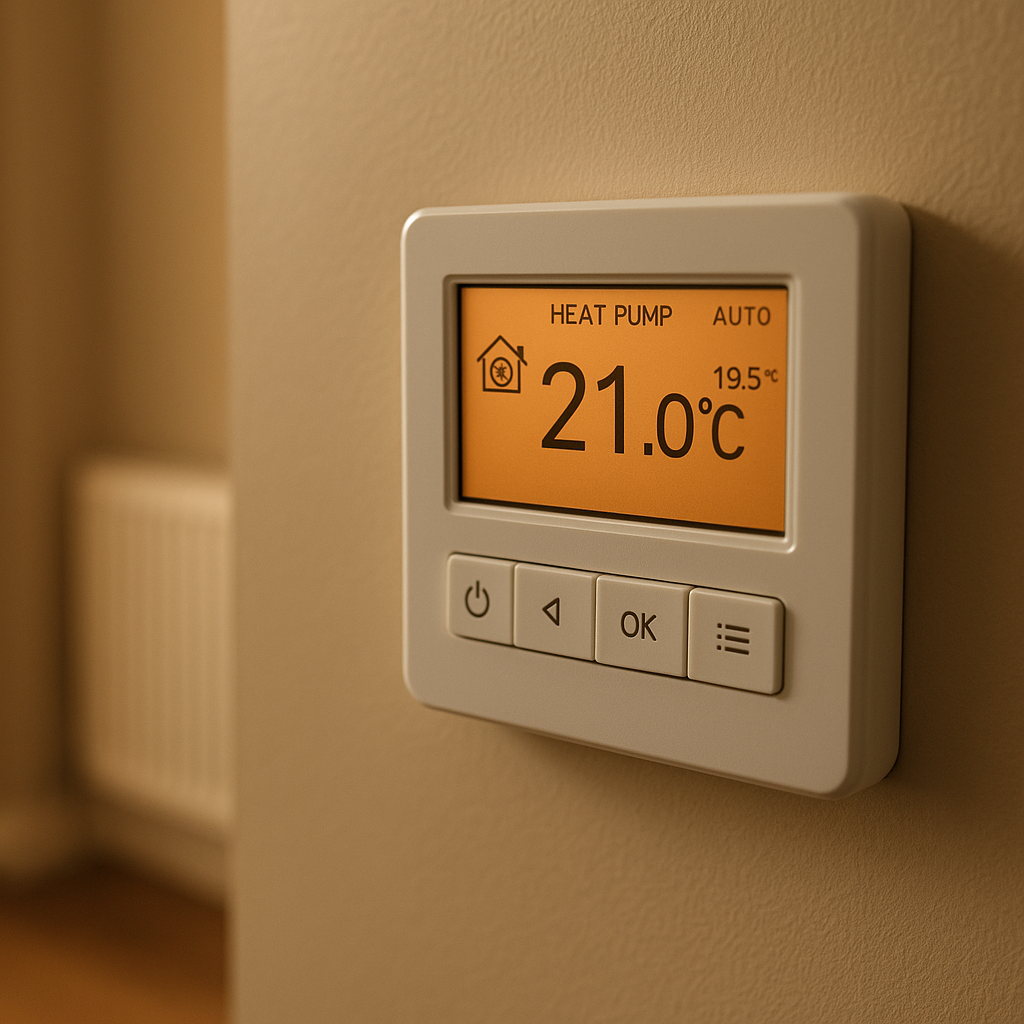
    Heat pump thermostat control panel inside a UK home, showing energy settings relevant to heat pump adoption UK

    Is Your Home Ready for a Heat Pump?

    Heat pumps operate at lower flow temperatures than gas boilers. This means they work best when paired with well-insulated properties and larger radiators or underfloor heating. A Victorian terrace with single-glazed windows and no loft insulation will struggle to retain the heat a pump delivers. Fabric-first improvements matter enormously here, and investing in quality home insulation before or alongside a heat pump installation is widely regarded as essential to getting the performance figures the manufacturers advertise.

    The Energy Performance Certificate (EPC) rating of your property gives a useful starting point. Homes rated C or above are generally well-suited to heat pump technology. D-rated properties can still benefit, but may need supplementary works. E, F, and G-rated homes typically require substantial fabric improvements before a heat pump makes financial sense.

    A good installer will carry out a heat loss calculation for your property before recommending a system size. Be wary of anyone who skips this step.

    Regional Installer Availability Across the UK

    Installer capacity has been a genuine bottleneck. The MCS-certified installer network has grown, but distribution is uneven. London and the South East have the highest density of accredited heat pump engineers. Scotland and Wales have seen strong growth partly driven by devolved funding, with the Scottish Government’s Home Energy Scotland scheme offering additional loans on top of BUS grants.

    In the North of England and parts of the Midlands, wait times for survey appointments can run to six to eight weeks. Rural areas pose specific challenges: properties in counties like North Yorkshire, Cumbria, or Shropshire may have fewer local options and face higher travel costs built into quotes. The government’s Heat Pump Ready programme has funded training to address skills shortages, and the number of MCS-certified heat pump engineers in the UK rose by over 30% between 2023 and 2025, but demand is still outpacing supply in some regions.

    Comparing at least three quotes through the MCS installer directory is sensible practice regardless of where you live. Prices for identical systems can vary by 20-25% depending on the installer.

    Practical Steps Before You Commit

    Getting the decision right requires a bit of groundwork. First, check your property’s EPC and identify any low-cost fabric improvements that could be done beforehand. Second, use the Energy Saving Trust’s online tool to get a rough sense of whether your home suits an ASHP or ground source system. Third, contact at least three MCS-certified installers and ask each one for a full heat loss survey before they quote.

    The broader financial context matters too. If you’re already thinking about ways to reduce household running costs, the kind of practical financial decisions UK households are increasingly making in 2026 extend well beyond energy systems. There’s a wider pattern of people looking at how their household finances and working life intersect under cost-of-living pressure, and energy efficiency investments sit squarely within that trend.

    Heat pumps are not the right fit for every home today, but for properties with decent insulation, working radiators, and an owner willing to engage with time-of-use tariffs, the financial and practical case has never been stronger. The grants won’t last forever, and gas boiler replacement will become mandatory for new builds and eventually existing homes. Getting ahead of that timeline is increasingly starting to make sense.

    Frequently Asked Questions

    How much is the UK government grant for a heat pump in 2026?

    The Boiler Upgrade Scheme currently provides a £7,500 grant for both air source and ground source heat pumps. The grant is paid directly to your MCS-certified installer and deducted from your installation invoice, so you never need to handle the funds yourself.

    Are heat pumps cheaper to run than gas boilers in the UK?

    It depends on your tariff and property insulation. With a dedicated heat pump electricity tariff and a well-insulated home, many households achieve running costs broadly comparable to, or lower than, a modern gas boiler. The gap narrows significantly when off-peak electricity rates are used to pre-heat water overnight.

    What EPC rating do I need for a heat pump to work efficiently?

    A rating of C or above is generally considered the threshold for straightforward heat pump installation. D-rated properties can work but may need radiator upgrades or additional insulation first. Properties rated E or below usually require substantial fabric improvements before a heat pump delivers good results.

    How do I find a qualified heat pump installer near me?

    Search the MCS (Microgeneration Certification Scheme) installer directory at mcscertified.com, which lists all accredited heat pump engineers by postcode. Only MCS-certified installers can submit Boiler Upgrade Scheme grant applications on your behalf, so using the directory is essential rather than optional.

    What is the difference between an air source and a ground source heat pump?

    Air source heat pumps extract heat from outdoor air and are suitable for most properties; they cost roughly £8,000 to £15,000 installed. Ground source systems use pipes buried in your garden or bored vertically underground, are more efficient but significantly more expensive at £15,000 to £35,000, and require sufficient outdoor space for the groundwork.

  • How UK Workers Are Using AI Productivity Tools to Beat the Cost-of-Living Squeeze in 2026

    How UK Workers Are Using AI Productivity Tools to Beat the Cost-of-Living Squeeze in 2026

    Wages have crept upward in nominal terms, but for most British workers the real-terms picture remains tight. According to the ONS earnings data, average regular pay growth has struggled to keep pace with cumulative price rises since 2021, leaving households across England, Scotland, and Wales quietly hunting for ways to do more with less. One response that has gathered serious momentum this year is the widespread adoption of AI productivity tools, not as a novelty, but as a genuine financial strategy.

    UK worker using AI productivity tools at a home office desk in a British terraced house

    Why Workers Are Turning to AI Productivity Tools Right Now

    The motivations differ depending on who you speak to. A freelance copywriter in Leeds might use an AI writing assistant to halve the time she spends on first drafts, effectively doubling her hourly rate without raising her day rate. A project manager in Cardiff might lean on an AI scheduling tool to compress two hours of coordination into twenty minutes, freeing up time for a side consultancy he runs on evenings. A customer service worker in Glasgow might use a transcription and summarisation tool to clear admin backlogs that used to eat into unpaid overtime.

    The common thread is time-to-money conversion. When you cannot easily negotiate a pay rise, the next lever is either reducing costs or making your working hours worth more. AI productivity tools sit squarely in the second camp, and the learning curve has dropped sharply. Many of the most useful tools now require no technical knowledge whatsoever.

    What UK Employees Are Actually Using

    Adoption patterns vary by sector, but a few categories stand out as particularly popular amongst British workers this year.

    Writing and content assistance

    Tools that help draft emails, summarise documents, or generate structured reports have become routine for knowledge workers. Many employees report using these to manage communication loads that grew substantially during the remote-working era and never fully shrank back. The time savings are tangible: cutting ninety minutes of inbox management to forty-five minutes every day adds up to roughly four working days a month.

    Transcription and meeting summaries

    For those in client-facing or management roles, automated transcription tools have replaced manual note-taking. Several freelancers in the north-west have told me they use these to service more client calls per week without sacrificing accuracy, a practical way to grow revenue without working longer hours.

    Personal finance and tax organisation

    Self-employed workers and sole traders are increasingly using AI-assisted bookkeeping tools to prepare their self-assessment returns more efficiently. With HMRC’s Making Tax Digital initiative expanding its reach, tools that can categorise receipts and generate expense summaries are genuinely saving freelancers money on accountancy fees.

    Close-up of a freelancer accessing AI productivity tools on a laptop keyboard

    The Freelance Economy and the Productivity Dividend

    Britain’s freelance workforce has grown considerably since 2020. Many people moved into self-employment precisely because it offered income flexibility, but the income volatility that comes with freelancing is harder to absorb when food, energy, and mortgage costs have all risen significantly. AI productivity tools offer freelancers something particularly valuable: the ability to scale output without scaling hours.

    A graphic designer in Bristol, for instance, can use AI-assisted design tools to produce initial mockups faster, giving her capacity to take on two additional small clients per month. At modest day rates, that difference could represent several thousand pounds in additional annual income, meaningful against a backdrop of stagnant real wages.

    For those who also run an online presence or sell services digitally, the productivity gains extend to visibility. One freelance consultant in Edinburgh described how streamlining his content output with AI tools freed up time to improve his website, after which he ran a free SEO audit that identified several quick wins which drove a noticeable uptick in enquiries within six weeks.

    Are There Genuine Risks to Factor In?

    Adopting any new tool carries risks, and AI productivity tools are no exception. The most frequently cited concern among UK workers is data privacy. Many tools are operated by US-based companies, and questions about where data is processed and stored are legitimate. Workers handling sensitive client information should check whether a tool is compliant with UK GDPR before integrating it into their workflow. The ICO’s guidance on AI and data protection is worth reviewing for anyone in doubt.

    There is also the question of dependency. Automating too much too quickly can erode skills that still matter for career development or client trust. The workers I have spoken to who have had the best experience with these tools tend to use them to handle repeatable, lower-value tasks, whilst keeping the thinking and relationship work firmly in their own hands.

    Cost is worth considering too. The free tiers of most AI tools are genuinely useful, but the higher-capability versions typically run to between £15 and £50 per month. For someone whose time savings clearly exceed that cost, the maths is straightforward. For others, it requires a bit more scrutiny before committing to a subscription.

    How Workers in Different Regions Are Feeling the Impact

    The economic pressure is not uniform across the UK. Workers in areas with higher housing costs relative to local wages, such as parts of the south-east outside London, or in post-industrial towns in the Midlands and Yorkshire, often feel the squeeze more acutely than regional averages suggest. In these communities, even modest productivity gains can make a meaningful difference to a household budget.

    Scotland and Wales have their own specific contexts too. Devolved decisions around income tax thresholds in Scotland mean higher earners there face a slightly different calculation around whether it is worth pushing for additional income versus managing their tax position. AI tools that help freelancers track earnings in real time have become particularly popular in these areas for exactly that reason.

    Getting Started Without Overcomplicating It

    The most common mistake people make is trying to overhaul their entire workflow at once. A more practical approach is to identify the single most time-consuming repeatable task in your working week, find one tool that addresses it well, and give it a genuine trial for a fortnight before adding anything else.

    Most mainstream AI productivity tools offer free trials or permanent free tiers. Microsoft Copilot is integrated into tools many UK workers already use through their employer’s Microsoft 365 licence. Notion AI, Otter.ai, and similar tools have accessible entry points. The barrier to starting is genuinely low.

    The workers getting the most value from these tools in 2026 are not necessarily the most technically confident. They are the ones who got specific about the problem they were trying to solve before picking up any tool at all.

    Frequently Asked Questions

    Which AI productivity tools are most popular with UK freelancers in 2026?

    Writing assistants like Microsoft Copilot and transcription tools like Otter.ai are widely used. AI-assisted bookkeeping tools are also gaining traction among sole traders managing their HMRC self-assessment obligations. The best choice depends on your specific workflow bottlenecks.

    Are AI productivity tools safe to use for work involving client data?

    It depends on the tool and how it processes data. UK GDPR applies, so you should check whether the tool stores or trains on your data and where servers are located. The ICO publishes guidance on AI and data protection that is worth consulting before adopting any new tool for professional use.

    How much do AI productivity tools typically cost in the UK?

    Many tools offer free tiers that are genuinely functional for individual use. Paid plans typically range from around £15 to £50 per month depending on capability. Some are bundled into existing software licences, such as Microsoft Copilot within Microsoft 365 Business subscriptions.

    Can AI tools really help with the cost-of-living pressure, or is it just hype?

    For many workers, the benefit is real but indirect. By reducing time spent on low-value tasks, AI tools can free up capacity to take on more paid work or reduce the need for outsourcing. ONS data confirms real-terms wage stagnation for many workers, making this kind of efficiency gain a practical rather than aspirational response.