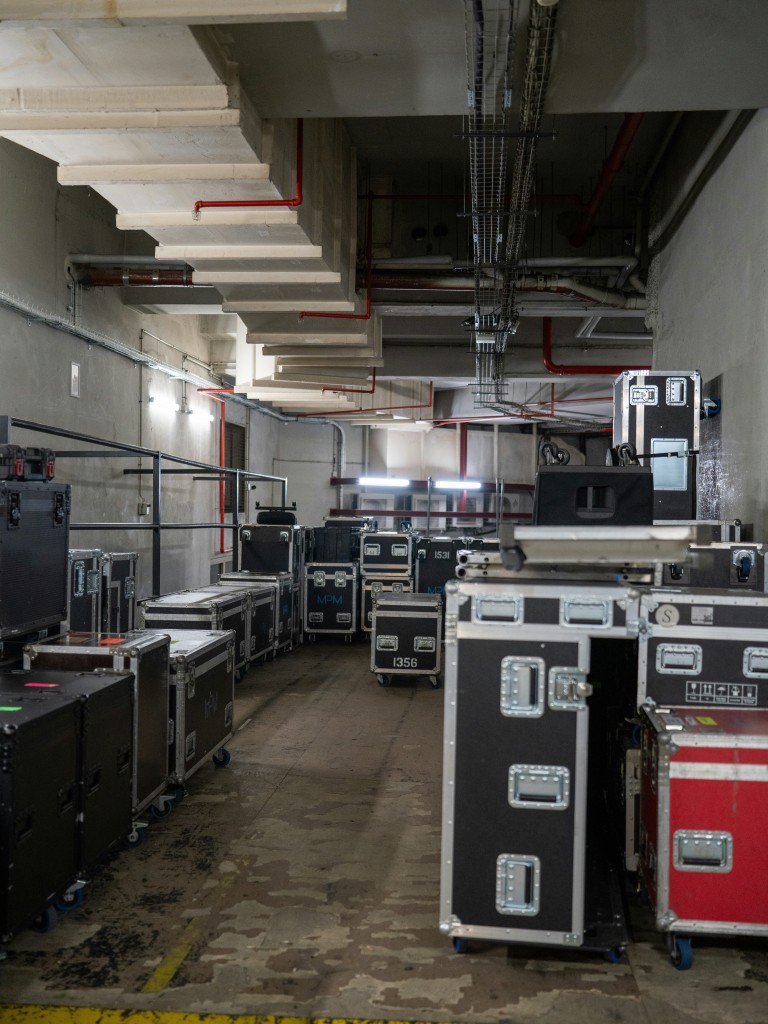
The audience sees ninety minutes. The crew sees a fourteen-hour day, most of which is spent moving objects into and out of a lorry. Touring production is a logistics discipline wearing a leather jacket, and the road case is its central artefact.
The case is the unit of everything
A flight case is a plywood box with an aluminium extrusion frame, ball corners, butterfly latches and foam inside cut to the shape of whatever it holds. It exists because a few hundred pounds of case is cheaper than a cancelled show.
But the case does more than protect. It defines the tour’s entire vocabulary. Everything is measured in cases. Truck space is calculated in cases. The load-in schedule is a sequence of cases. Crew are assigned to cases. When a production manager says a show is fourteen cases, everyone involved immediately understands the scale, the crew size and the vehicle.
That is why cases are standardised to stack and to fit truck widths. A case that does not stack wastes vertical space, and wasted vertical space on a lorry costs real money over a forty-date run.
Reverse order, always
Loading is done backwards from the perspective of the next venue.
The last thing off the truck is the first thing needed, so the truck is packed in reverse build order. Rigging and structure go in last and come out first, because nothing else can happen until the points are hung and the structure is up. Backline goes in earlier and comes out later. Merchandise, which nobody needs until doors, gets buried.
Get this wrong and the crew spends an hour unloading and reloading a lorry in the rain in Wolverhampton. Every touring crew has that story and nobody tells it fondly.
Colour, labels and the two in the morning test
The organising principle of a well-run tour is that any competent person should be able to do the right thing while exhausted.
Cases are colour-coded by department. Lighting is one colour, audio another, backline another. Labels are on multiple faces because you cannot guarantee which way a case ends up sitting. Cables are looped and tied identically every time so that a coiled cable can be identified by feel.
This is not fussiness. It is designing for the worst realistic conditions, which on a tour means the end of a long day in a room you have never been in before, in poor light, against a curfew.
The load-bearing part
Rigging is the point where touring stops being logistics and becomes a safety-critical engineering discipline.
Anything hung above people is subject to real legal duty in the UK. Lifting equipment falls under LOLER and PUWER, and the Health and Safety Executive publishes specific guidance for entertainment. Rigging points are certified. Equipment is inspected and logged. Riggers are qualified, and on a competent production nobody who is not qualified touches any of it.
The principle that trips up everyone outside the profession is the difference between static and dynamic load. A component rated to hold a given weight hanging still is not rated to hold that weight when it swings, and movement multiplies the force considerably. Published working load limits assume a safety factor for exactly that reason.
This crosses over into other worlds more than you might expect. Anyone building anything that takes human load and also has to come apart quickly ends up in the same territory, and the engineering behind stage rigging turns out to have a good deal in common with other fields that solved the same portability and load problems independently.
The unglamorous truth
Touring looks like rock and roll from the front and looks like a warehouse operation from the back. The bands that tour successfully for decades are almost always the ones with a production manager who is fanatical about case labelling.
It is not the part anyone puts on a poster. It is the part that means the show happens.
Sleep disorders are not a niche problem. The NHS estimates that roughly a third of British adults experience significant sleep difficulties at some point, and conditions such as obstructive sleep apnoea, insomnia disorder, and restless leg syndrome affect millions of people who are either undiagnosed or sitting on a waiting list long enough to cause serious harm to their health, relationships, and working lives. I’ve spoken to people who waited two and a half years for a sleep study referral to actually materialise. That is not an outlier figure.
NHS sleep clinic waiting times in the UK have worsened sharply since 2020, and the picture in 2026 remains difficult. Understanding why, and what your realistic options are, is genuinely useful if you or someone you know suspects a sleep disorder.
How long are NHS sleep clinic waiting times in the UK right now?
The honest answer is: it varies enormously by region, but the overall trend is poor. NHS England’s own referral-to-treatment data shows that respiratory sleep services, which cover most sleep apnoea diagnosis, frequently exceed the 18-week standard. In some areas of the country, patients are waiting 12 to 18 months just to receive an initial appointment at a sleep clinic, with polysomnography (the overnight sleep study used for definitive diagnosis) adding further delay on top.
Part of the pressure comes from sheer volume. Obesity rates in the UK have risen over the past decade, and obstructive sleep apnoea is strongly linked to body weight. The NHS’s guidance on sleep apnoea notes that the condition is significantly underdiagnosed, which means the cohort of patients eventually reaching GPs and referrals is growing year on year. Add to that a specialist workforce that has not kept pace with demand, and you have a system under genuine strain.
GP referrals themselves can be the first bottleneck. Many GPs are not trained sleep specialists and may not recognise or prioritise symptoms unless they are severe, a patient describing chronic tiredness without a partner’s account of loud snoring, for example, might not be fast-tracked appropriately.
What does private sleep diagnosis actually cost?
Growing numbers of people are bypassing NHS sleep clinic waiting times in the UK entirely by going private. The cost varies depending on what you need, but here is a realistic breakdown based on current pricing at UK private clinics.
A private sleep consultation with a respiratory physician or sleep specialist typically costs between £200 and £400 for the initial appointment. A home sleep test, where you wear a monitoring device overnight and return it for analysis, usually runs from £250 to £600 depending on the clinic and the complexity of the device. A full in-lab polysomnography study, conducted overnight in a private sleep suite, can cost anywhere from £1,000 to £2,500. Some private health insurers, including Bupa and Vitality Health, will cover these costs if your policy includes specialist consultations, though you will need to check the specific terms around pre-existing conditions.
London-based clinics such as the London Sleep Centre and the OneWelbeck Sleep Health clinic have seen significant demand growth. Outside the capital, private sleep services are available in cities including Manchester, Birmingham, and Edinburgh, though provision is patchier than in the south-east. If you are considering going private, a referral from your GP is not always required, but having one can help the specialist understand your full medical history from the start.
The rise of consumer sleep technology
Between the NHS queue and a £2,000 private sleep study sits a rapidly expanding middle ground: consumer sleep technology. Wearables, bedside monitors, and app-based analysis tools have become a legitimate part of how many people first investigate their sleep health, even if they cannot replace clinical diagnosis.
Devices such as the Withings Sleep Analyser, the Oura Ring, and various iterations of smartwatch sleep tracking from Garmin and Samsung can identify patterns, irregular breathing, elevated resting heart rate, prolonged light-sleep cycles, that give users a reason to push their GP more firmly for a referral. I’d argue these tools have been quietly useful in getting people to take their own symptoms seriously rather than brushing off tiredness as a lifestyle issue.
There are limits, of course. No consumer wearable is clinically validated to diagnose sleep apnoea or classify specific sleep disorders. The data can be noisy, and users should not treat an app’s sleep score as medical information. That said, several sleep specialists I’ve read interviews with have acknowledged that patients who arrive with months of wearable data are often better equipped to describe their symptoms and patterns than those relying on memory alone.
The cost-of-living context matters here too. With household budgets under sustained pressure, spending £2,000 on a private sleep study is simply not possible for a large portion of the population. A £300 wearable is not equivalent, but for people who genuinely cannot afford private diagnosis and face a two-year NHS wait, it can at least help them track whether their condition is stable or deteriorating. This kind of practical workaround is something we’ve seen in other areas of healthcare and consumer spending, much as UK workers have adopted AI productivity tools to manage the cost-of-living squeeze, people are applying tech-first thinking to health too.
CPAP therapy: getting treatment once diagnosed
Diagnosis is only the first part. For people with obstructive sleep apnoea, the standard treatment is a CPAP (Continuous Positive Airway Pressure) machine, which keeps the airway open during sleep. The NHS provides CPAP equipment free of charge once a diagnosis is confirmed, which is a significant benefit of persisting through the NHS route. Private patients who purchase or rent CPAP machines directly are typically looking at between £400 and £1,200 for the device, plus ongoing costs for masks and filters.
Some private providers now offer a streamlined pathway: home sleep test, remote analysis by a sleep physician, and CPAP rental or purchase, all within a few weeks rather than years. Companies operating in this space include Intus Healthcare and ResMed’s UK arm. The convenience is real, but so is the ongoing expense if you are managing a lifelong condition without NHS support.
What to do if you suspect a sleep disorder
Start with your GP. Ask specifically for a referral to a sleep clinic rather than a general respiratory service, and be explicit about how your symptoms are affecting your daily functioning, your ability to work, and your safety, particularly if you drive. Daytime sleepiness caused by untreated sleep apnoea is a recognised road safety risk, and the DVLA has specific rules about drivers with the condition.
If the wait time your GP quotes is more than six months, ask whether your NHS trust has a Choose and Book option to access a different provider with shorter waits, or whether a home sleep test referral might be faster than an in-lab study. These are not unreasonable questions to ask.
If you can afford it and the wait is genuinely affecting your health or safety, private diagnosis is a legitimate path. It is also worth checking whether your employer’s private health benefit, if you have one, covers sleep-related consultations, as this is sometimes overlooked. In much the same way that rising household energy costs have pushed people to consider alternative home energy solutions, the NHS backlog is pushing people to find alternative routes to healthcare that they might not previously have considered.
The demand problem is structural and will not be solved quickly. But knowing your options, both within the NHS and outside it, puts you in a much stronger position to actually get help rather than waiting indefinitely.
Frequently Asked Questions
How long is the NHS sleep clinic waiting time in the UK?
Waiting times vary significantly by region, but many NHS sleep clinics in the UK currently exceed the 18-week referral-to-treatment standard. In some areas, patients are waiting 12 to 18 months or longer for an initial appointment. Home sleep tests may be offered faster than in-lab polysomnography studies.
How much does a private sleep study cost in the UK?
A home sleep test at a private clinic typically costs between £250 and £600, while a full overnight polysomnography study can cost £1,000 to £2,500. Initial consultations with a private sleep specialist usually run between £200 and £400. Some private health insurance policies will cover these costs.
Can a smartwatch or wearable diagnose sleep apnoea?
No consumer wearable is clinically validated to diagnose sleep apnoea or other sleep disorders. Devices like the Oura Ring or Garmin smartwatches can track patterns in breathing and heart rate that may prompt you to seek medical advice, but they cannot replace a clinical sleep study.
The narrative around the British high street has been bleak for a long time. Empty units, charity shops filling gaps left by chains, and town centres that felt like they’d given up. But in 2026, that picture is more complicated than the doom-laden headlines suggest. A growing number of UK towns have turned their fortunes around, and the approaches they’ve taken tell us something genuinely useful about what the high street can become.
The British Retail Consortium reported in early 2026 that footfall in market towns with a high proportion of independent retailers had grown by 4.7% year-on-year, outpacing retail parks and shopping centres for the second consecutive year. That’s not a fluke. It reflects deliberate decisions made by councils, local business communities, and residents who chose not to wait for a national chain to save them.
Frome: the Somerset model everyone is copying
Frome in Somerset is probably the most cited example of a town that reinvented itself, and the results have held up. Its independent traders now account for around 70% of the retail offer, and the monthly Frome Independent market draws visitors from across the South West. The council’s decision to reduce business rates support for large chains while actively funding pop-up incubator spaces gave smaller operators a genuine foothold.
What made Frome work wasn’t just the market. It was the deliberate mixing of retail with cultural venues. Merlin Theatre hosts everything from fringe comedy to community forums. The library was expanded rather than cut. These aren’t luxury add-ons; they’re the reason people come and stay long enough to spend money.
Tynemouth and the north-east coast revival
Tynemouth in North Tyneside has built its reputation on a weekend market that now runs year-round inside the Victorian train station. The market operates under a licence from Network Rail, and it attracts craft producers, vintage dealers, and food vendors from across the region. North Tyneside Council’s regeneration report for 2025 credited the station market with generating an estimated £2.1 million in additional local spending annually.
The town hasn’t ignored its challenges either. Counterfeit goods being sold through informal pop-up stalls became a real problem in 2023, and the council worked with Trading Standards to tighten vendor vetting. If you encounter suspicious sellers online trying to mimic legitimate local markets, you can report a scam UK through dedicated channels to flag it quickly. Keeping local commerce trustworthy matters as much as the physical regeneration.
Ludlow: quality over volume
Ludlow in Shropshire takes a different approach. The town actively positions itself around food quality, with a higher concentration of artisan food producers and specialist shops than almost anywhere else of its size in England. The annual Ludlow Food Festival draws around 20,000 visitors each year, but the real work happens in the ordinary weeks when independent butchers, cheesemongers, and delicatessens maintain a trading environment that chains simply can’t replicate.
Shropshire Council’s 2025 town centre health check placed Ludlow vacancy rates at just 6%, compared to a national average hovering around 14% according to the BRC. That gap matters. Empty units don’t just look bad; they create feedback loops where the remaining businesses see reduced footfall and start questioning their own position.
What councils are actually doing differently
The towns managing a genuine UK high street revival share a few structural habits. First, they’ve converted upper floors of commercial buildings into flats, bringing residents directly into the town centre rather than leaving them in car-dependent suburbs. Bristol City Council and Shrewsbury Borough have both run active programmes to convert vacant retail upper floors under permitted development rights, and the results show in footfall during evenings and weekends.
Second, parking policy has shifted. Several thriving towns have dropped the first hour of parking fees entirely, a move that sounds small but removes the psychological friction that pushes shoppers towards retail parks where parking is free. Skipton in North Yorkshire tried this in 2024 and reported a 9% increase in town centre visits within six months, according to the council’s own monitoring data.
Third, and perhaps most tellingly, the successful towns have treated culture as infrastructure. Libraries, arts venues, community halls, and even well-maintained public spaces generate the kind of dwell time that translates into retail spending. The pressure on household budgets in 2026 means people are more selective about where they choose to spend. A pleasant, interesting town centre clears that bar. A sad row of closed units does not.
The role of independent retail specifically
There’s a distinction worth drawing here. The UK high street revival being led by independent retailers isn’t simply nostalgia for small shops. It’s a structural shift in what consumers want from a physical retail experience. Independents offer things chains structurally cannot: genuine local knowledge, products you won’t find in fifty identical shops elsewhere, and a reason to come back when the range changes.
Hebden Bridge in West Yorkshire has built an entire local economy around this. Its independent bookshops, galleries, and specialist outdoor gear retailers create an ecosystem where one shop’s customer becomes another’s. The town’s arts calendar, including the annual Hebden Bridge Arts Festival, brings in visitors who wouldn’t otherwise come, and those visitors spend in the shops.
What the data says about the rest
Not every town is Frome or Ludlow. The BRC’s 2026 retail monitor found that towns dominated by large retail chains continue to see vacancy rates climb as those chains contract their physical footprints. This isn’t a mystery. A high street that depends on one or two anchor tenants is fragile, and that fragility has been obvious since the Debenhams closures accelerated the pattern in 2021.
The towns at serious risk are generally mid-sized places with neither the independence-friendly culture of smaller market towns nor the footfall and transport links of major cities. For those towns, the regeneration task is harder. Council funding through the UK Shared Prosperity Fund has helped in some cases, but the allocations vary significantly and the spending timelines don’t always match the pace at which units empty.
The lesson that emerges from the towns getting it right is straightforward. The high street doesn’t survive by being convenient. It survives by being worth the trip. Towns that have understood that and built accordingly are doing well. Those still waiting for a national chain to anchor their recovery are, in most cases, still waiting. Thinking about how household decisions connect to broader economic pressures, including energy costs and home investment choices, helps explain why localised, community-led economies are drawing more loyalty from residents who want their spending to stay close to home.